On November 4, 2011 I was interviewed by Panafrican TV channel Vox Africa on the challenges Cameroon will have to face during Paul Biya's 6th term. Here is my take on the necessity for the country to reorganise the political scene:
Affichage des articles dont le libellé est Civil Society. Afficher tous les articles
Affichage des articles dont le libellé est Civil Society. Afficher tous les articles
mardi 8 novembre 2011


mardi 29 mars 2011
Human Rights campaigns and disturbing shortcuts: Amnesty International Case
Wandering on my Facebook Friends photo albums, I fell on this:

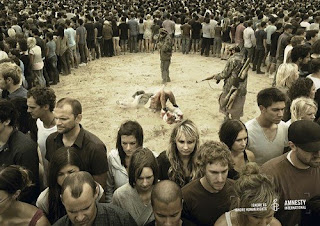

It is a 2010 Human Rights campaign by Amnesty International New Zealand, and I must say that It puzzled me.
I think the work of such an organisation remains important, but here I think the NGO made a marketing mistake.
To contextualize, let us remember what Amnesty International is about.
According to the wikipedia page, Amnesty was created in July 1961 after the founder Peter Benenson published an article "Forgotten prisoners" in which he denounced violations of the Universal Declaration of Human Rights perpetrated by Governments. The Wikipedia article further reminds the role played by the organisation in pressures on South African Apartheid Government in the early 1990s to investigate into allegations of police abuse.
Despite this incredible History and contribution, the Human Rights activist that I am feels uncomfortable with the "Ignore Us" Campaign.
As you can see, the three different scenes show at the center people who seem to be from the former "third world", usually a man committing violence on another Humanbeing. And surrounding them, people from the so called Western World, mainly caucasian type persons, who are turning their backs on the violent scene. The "uncolored" aspect of the crowd is more evident on the foreground.
And that is exactly what first struck me : The population in the Western World is mixed, composed of Afro-Europeans, Asian-Americans, or South-American Australians who can afford to give funds to Amnesty International. I did not understand why the only people targeted because they ignore human rights violations in the world were the Caucasian Westerners. Nathalie, author of an article published on the site non-profit communication, gave an aspect of the answer: She explains that the campaign was made by Amnesty International New Zealand, and thus the local section of the organisation decided to target the type of population you can find in the country ie:
Another element that cought my eyes of African Woman living in a western country is the fact that at the centre of each scene, the people perpetrating the violences are "Third-World" type : African or Asian from the Middle-East. To me, this tends to suggest that Human Rights violations are commonly committed in "Southern" Areas of the world.
This led me to investigate a bit more on the countries mostly covered by Amnesty and I found this report by James Ron, Howard Ramos and Kathleen Rodgers, "Transnational Information Politics: NGO Human Rights Reporting, 1986–2000" which discusses the elements which push an International NGO like Amnesty International to cover a part of the world more than another:
I particularly was interested by one of the tables which shows Amnesty's 10 top target countries between 1986 and 2000 in the organisation's publications. And surprisingly enough, there is only one African Country in the List, Rwanda, for which 64 press releases were published, ie 2% of the Total number of Press releases:

It is true that the "Greatest" violations, if you consider there is a scale for this, are committed in the South, nevertheless I feel like the message of this campaign does not show that Human Rights violations are unfortunately also a reality in the Northern part of the World, and non Caucasian populations of these countries ignore that rights of some of their fellow-citizens are violated.

Marketing reasonning should remain intellectually honest, and not elude reality, especially when it comes to such sensitive issue; otherwise the credibility can be lost and the audience might be diverted from a powerful and thougthful message, which is in our particular case : Human Rights are violated while we are not paying attention.
Amnesty International New Zealand's campaign is what I consider a counterproductive marketing coup: in fact it gives food for thought to "Thirld World" populists who present NGOs as organisations serving interests of Western Powers, and it contributes to discredit the necessary action of such organisation in certain areas of the World.
But all this was probably a calculated faux-pas: thanks to a coincidence of the calendar, Columbia Journalism Review published on its website an article, "Hiding the Real Africa, Why NGOs prefer bad news", which explains why NGOs have more interest to show an Africa torn by Wars and Tribal slaughters, rather than giving images of a healthy and growing continent. And to sum up the idea, the poorer Africa is, the richer these NGOs and other International Organisations become:


It is a 2010 Human Rights campaign by Amnesty International New Zealand, and I must say that It puzzled me.
I think the work of such an organisation remains important, but here I think the NGO made a marketing mistake.
To contextualize, let us remember what Amnesty International is about.
According to the wikipedia page, Amnesty was created in July 1961 after the founder Peter Benenson published an article "Forgotten prisoners" in which he denounced violations of the Universal Declaration of Human Rights perpetrated by Governments. The Wikipedia article further reminds the role played by the organisation in pressures on South African Apartheid Government in the early 1990s to investigate into allegations of police abuse.
Despite this incredible History and contribution, the Human Rights activist that I am feels uncomfortable with the "Ignore Us" Campaign.
As you can see, the three different scenes show at the center people who seem to be from the former "third world", usually a man committing violence on another Humanbeing. And surrounding them, people from the so called Western World, mainly caucasian type persons, who are turning their backs on the violent scene. The "uncolored" aspect of the crowd is more evident on the foreground.
And that is exactly what first struck me : The population in the Western World is mixed, composed of Afro-Europeans, Asian-Americans, or South-American Australians who can afford to give funds to Amnesty International. I did not understand why the only people targeted because they ignore human rights violations in the world were the Caucasian Westerners. Nathalie, author of an article published on the site non-profit communication, gave an aspect of the answer: She explains that the campaign was made by Amnesty International New Zealand, and thus the local section of the organisation decided to target the type of population you can find in the country ie:
78% European/Other, 14.6% Māori, 9.2% Asian, 6.9% Pacific peoples.
About 74.5% of the population is classified as New Zealand European; 9.7% Maori; 4.6% are considered other European; 3.8% Pacific Islander; and 7.4% Asian and others.
Another element that cought my eyes of African Woman living in a western country is the fact that at the centre of each scene, the people perpetrating the violences are "Third-World" type : African or Asian from the Middle-East. To me, this tends to suggest that Human Rights violations are commonly committed in "Southern" Areas of the world.
This led me to investigate a bit more on the countries mostly covered by Amnesty and I found this report by James Ron, Howard Ramos and Kathleen Rodgers, "Transnational Information Politics: NGO Human Rights Reporting, 1986–2000" which discusses the elements which push an International NGO like Amnesty International to cover a part of the world more than another:
What shapes the transnational activist agenda? Do NGOs with a global mandate focus on the world's most pressing problems or is their reporting also affected by additional considerations?
I particularly was interested by one of the tables which shows Amnesty's 10 top target countries between 1986 and 2000 in the organisation's publications. And surprisingly enough, there is only one African Country in the List, Rwanda, for which 64 press releases were published, ie 2% of the Total number of Press releases:

It is true that the "Greatest" violations, if you consider there is a scale for this, are committed in the South, nevertheless I feel like the message of this campaign does not show that Human Rights violations are unfortunately also a reality in the Northern part of the World, and non Caucasian populations of these countries ignore that rights of some of their fellow-citizens are violated.

Marketing reasonning should remain intellectually honest, and not elude reality, especially when it comes to such sensitive issue; otherwise the credibility can be lost and the audience might be diverted from a powerful and thougthful message, which is in our particular case : Human Rights are violated while we are not paying attention.
Amnesty International New Zealand's campaign is what I consider a counterproductive marketing coup: in fact it gives food for thought to "Thirld World" populists who present NGOs as organisations serving interests of Western Powers, and it contributes to discredit the necessary action of such organisation in certain areas of the World.
But all this was probably a calculated faux-pas: thanks to a coincidence of the calendar, Columbia Journalism Review published on its website an article, "Hiding the Real Africa, Why NGOs prefer bad news", which explains why NGOs have more interest to show an Africa torn by Wars and Tribal slaughters, rather than giving images of a healthy and growing continent. And to sum up the idea, the poorer Africa is, the richer these NGOs and other International Organisations become:
These organizations understandably tend to focus not on what has been accomplished but on convincing people how much remains to be done. As a practical matter, they also need to attract funding.
lundi 7 février 2011
Global Voices - Gabon: The Invisible Revolt
My latest Global Voices article on the situation in Gabon. After the swearing in of André Mba Obame, the country entered a period of turmoil, which hasn't been reported in the traditional medias. After Tunisia and Egypt, are we witnessing another revolution in Africa ? Seems like things will not be the same anymore on the Continent.
"Protests in Gabon have failed to make a dent in the international news cycle as all eyes are still turned towards the Egyptian crisis. Mohamed Keita of the Committee to Protect Journalists (CPJ) was wondering if "fake news wasn't drawing real censorship" in Gabon, as he discussed the closing of the 1st private Gabonese TV channel, TV+. According to M Keita, the overreaction by the Ali Bongo's government is a sign of a deeper concern : what was considered ridiculous by Ali Bongo and his partisans before seems to have created subtantial political turmoil in this little Central African nation.
The rhetorical strategy of Bongo's camp seems to consist of the total denyial of the opposition party.
Sekou Oumar Doumbia, a Bongo partisan, writes on Ali Bongo's Facebook page:
Mass Protests in Libreville and the UNDP building attack
Thanks to locally based activists, there has a been a coverage of the events, and the latter was advertised through different social networks.
Last saturday a demonstration was organised at Carrefour Rio in Libreville, the Capital city. More than 2000 Mba Obame's partisans went to protest against Ali Bongo's government and faced the public forces.
[caption id="attachment_192476" align="aligncenter" width="375" caption="Demonsration, Carrefour Rio in LIbreville January 29th 2011"] [/caption]
This demonstration was followed by violent clashes between Mba Obame's partisans and Ali Bongo's Police forces, who were trapped by groups of demonstrators in slums near the place where the demonstration started.
The same day, Military forces were ordained to attack the United Nations Program for Development (UNDP) building in Libreville, where Mba Obame and his Government sought asylum. Camarade, a Gabonese activist, posted on his blog (fr) pictures showing some victims of the attack:
[caption id="" align="aligncenter" width="324" caption="Mba Obame's Partisan after UNDP attack 29th January 2011-(c) Camarade on LePost"] [/caption]
Voice of the Gabonese people (La voix du Peuple Gabonais LVDPG) reports on its website (fr) that 2000 other persons demonstrated in Bitam (fr), in the North of the country, on Monday 31st January. On the same site, it is said that Riots occured in many districts (fr) of Libreville on 2nd February. In Atong Abè, one Policeman was wounded.
Franklin explains on Twitter :
[caption id="attachment_192512" align="aligncenter" width="375" caption="Meyo-Kye, North Gabon, 2nd February 2011"] [/caption]
[caption id="attachment_192499" align="aligncenter" width="375" caption="Cars burnt in Atong Abè, Libreville, after riots on 2nd February"] [/caption]
Wave of arrest of sympathisers and executives
A dozen of executives ans sympathisers of the National Union (NU), main opposition party, have been arrested during the last five days. Koaci.com published a Press release by President of NU:
"Protests in Gabon have failed to make a dent in the international news cycle as all eyes are still turned towards the Egyptian crisis. Mohamed Keita of the Committee to Protect Journalists (CPJ) was wondering if "fake news wasn't drawing real censorship" in Gabon, as he discussed the closing of the 1st private Gabonese TV channel, TV+. According to M Keita, the overreaction by the Ali Bongo's government is a sign of a deeper concern : what was considered ridiculous by Ali Bongo and his partisans before seems to have created subtantial political turmoil in this little Central African nation.
The rhetorical strategy of Bongo's camp seems to consist of the total denyial of the opposition party.
Sekou Oumar Doumbia, a Bongo partisan, writes on Ali Bongo's Facebook page:
"Continuez de travailler et laissez les ridicules rêver."
"Keep on working and let the ridiculous people dream on"
Nevertheless, the situation appears more complicated: In the last five days, the country has witnessed excivil unrest. But IQ4News, a columnist style magazine website dedicated to African related issues, noticed that Protests in Gabon "have gone largely unnoticed by the media because of the focus on Egypt."Mass Protests in Libreville and the UNDP building attack
Thanks to locally based activists, there has a been a coverage of the events, and the latter was advertised through different social networks.
Last saturday a demonstration was organised at Carrefour Rio in Libreville, the Capital city. More than 2000 Mba Obame's partisans went to protest against Ali Bongo's government and faced the public forces.
[caption id="attachment_192476" align="aligncenter" width="375" caption="Demonsration, Carrefour Rio in LIbreville January 29th 2011"]
[/caption]This demonstration was followed by violent clashes between Mba Obame's partisans and Ali Bongo's Police forces, who were trapped by groups of demonstrators in slums near the place where the demonstration started.
The same day, Military forces were ordained to attack the United Nations Program for Development (UNDP) building in Libreville, where Mba Obame and his Government sought asylum. Camarade, a Gabonese activist, posted on his blog (fr) pictures showing some victims of the attack:
[caption id="" align="aligncenter" width="324" caption="Mba Obame's Partisan after UNDP attack 29th January 2011-(c) Camarade on LePost"]
[/caption]Voice of the Gabonese people (La voix du Peuple Gabonais LVDPG) reports on its website (fr) that 2000 other persons demonstrated in Bitam (fr), in the North of the country, on Monday 31st January. On the same site, it is said that Riots occured in many districts (fr) of Libreville on 2nd February. In Atong Abè, one Policeman was wounded.
Franklin explains on Twitter :
"Gabon:Crise politique:Soulèvements populaires en cours; quartiers pauvres de Nkembo, Cocotiers, Gare-routière, Atong Abè. Un blessé grave."
"Gabon: Political crisis: Uprising of the people happening now; poor districts of Nkembo, Cocotiers, Gare-Routière, Atong Abè. One serious wounded."
[caption id="attachment_192512" align="aligncenter" width="375" caption="Meyo-Kye, North Gabon, 2nd February 2011"]
[/caption]"In Tunisia, Ben ALi left. In Gabon, Ali Ben Out."
[caption id="attachment_192499" align="aligncenter" width="375" caption="Cars burnt in Atong Abè, Libreville, after riots on 2nd February"]
[/caption]Wave of arrest of sympathisers and executives
A dozen of executives ans sympathisers of the National Union (NU), main opposition party, have been arrested during the last five days. Koaci.com published a Press release by President of NU:
"A 5 heures du matin plusieurs compatriotes ont été arrêtés, brutalisés et transférés au camp Aïssa (caserne du Bataillon des parachutistes gabonais), puis au camp de gendarmerie de Gros-Bouquet, avant d’être finalement gardés à vue, à partir du 28 janvier, dans les sous-sols de la Direction générale des Recherches de la Gendarmerie Nationale et ce, au mépris de la loi qui interdit toute garde à vue au-delà de 72h."
"5 am several comrades were arrested, brutalised, and transferred to the Aïssa camp ( Barrack of the Gabonese Paratroopers' battalion), then to the Gros-Bouquet Police Station's camp, before being placed in custody, from 28th January, in the cellar of the Research General Direction of the National Gendarmerie. Doing this they violated the law which forbidds above 72 hours custody."
The Putative Minister of Foreign Affairs, Bruno Ben Moubamba, tweeted this morning about the kidnapping of the son of a Gabonese MP, Alexis Bengone:"Organized Repression & Brutality in Gabon. Former Prime minister' Son kidnapped by hooded men. #revogab#egypt #tunisia #civ2010"Some assume that his arrest is related to his online activism. He manages the "Gabao Res Publica" social network, and might have tried to raise youth with this article: "Gabon: A generation in quest of Democratic sense"."
jeudi 4 novembre 2010
Ivory Coast presidential elections in the age of Web 2.0
Here is an article I wrote for Internet Without Borders website. You can also find a french version here.
Ivorian presidential elections Took place. After months of turmoil and wrangling, the Ivorians have taken part in the first round of elections held Sunday, October 31, 2010.
The holding of the first round in a calm general atmosphere was welcomed by most commentators in the mainstream international press and observers.
New this year, online participation of many citizens of Cote d'Ivoire who organized coverage of the election day using the variety of tools available on the Internet.
New this year, online participation of many citizens of Cote d'Ivoire who organized coverage of the election day using the variety of tools available on the Internet.
Freedom of communication by SMS maintained
Contrary to the announcement of the Telecommunications Agency of Côte d'Ivoire (ATCI) last Saturday about the suspension of SMS, all means of communication were maintained. The regulator had proposed the measure for reasons of public order and to prevent the spread of "rumors". Prime Minister Guillaume Soro returned to this decision at a press conference Saturday afternoon. Maintenance by the Government of Freedom of Information and Communication in Côte d'Ivoire during the first round of elections would prove the political maturity of citizens and political actors.

"Let us solve all our problems in peace"
Note especially the initiative of Diaby Cheik Mohamed which reflects the general mood in the streets of Ivory Coast: the will to turn this election period in time of reconciliation. The Peacevote project encourages site visitors to leave messages for peaceful Côte d'Ivoire. Site promotion was done by many voices of culture in Côte d'Ivoire: Aicha Kone, Ismael Isaac ...
CoveritLive on the site Avenue225
Israel Yoroba, a journalism student and blogger and his team of Avenue225, Ivorian information site, made the story of voting and the general atmosphere prevailing in various parts of Côte d'Ivoire. Coverage outside major cities brought a wealth of additional information. Throughout the day, real-time information of events was ensured by CoveritLive application.
The France24 Observers
An interesting coverage was also put in place by France24 Observers. Thanks to two citizen journalists, we were informed that agents of the Electoral Independant Commission (IEC) were still waiting to receive wages for their work in polling stations.
The Election Buzz on Twitter
On the social network Twitter, hashtags #civ2010 #wonzomai and #peacevote, typed hundreds of times, are also a source of information for obtaining real-time news on the election by the citizens of Côte d'Ivoire: For instance incidents in polling stations in the Paris area were immediately reported by Twitter usersvia their mobile phones. The user @ MaryMary225 reported pushings and damages caused in Créteil (France).
Thanks to these elections, the Ivorian Twitter community has been strenghthened: New twitter accounts were updated and created, as notices by Twitter user Toussine


Election results monitored and updated online
AlldenY, A french web dev and strategies company, put in place a website where citizens and others can find the results of the ballot as given by the EIC. Graphs give an interesting overview of trends.
The platform Wonzomai
The platform deployed by Akendewa and Internet without Borders, Wonzomai, is a new experience in Francophone Africa. More than one Thousand visitors were well connected on Election Day, less than a week after its launch. It has mainly contributed to the Ivorian citizen outside who could thus have a glimpse of the vital information collected via Twitter.
One difficulty, appeared: automatic replication of information received via SMS has not worked properly on election day for technical reasons. However, a manual transcription of major incidents and statements received was made by Internet Without Borders and Akendewa teams. Also the necessity to link the various election monitoring organizations on the ground and teams that operate for the platform became obvious.
What about Facebook ?
Hundreds of thousands of Ivorians are connected to the social networking site Facebook. As well as reviews and politics discussions occured among users, candidates have used the network to campaign, for instance the outgoing President Laurent Gbagbo, whom many users left messages of encouragement during the campaign. Ivorian Internet users have also shared their photographs on voting day. For example Nnenna Nwakanma subscribed on Faceboo who posted the link to an album created specially for the occasion.
Inscription à :
Articles (Atom)